
Now accepting NHS & private patients Now accepting NHS & private patients Now accepting NHS & private patients Now accepting NHS & private patients Now accepting NHS & private patients Now accepting NHS & private patients Now accepting NHS & private patients Now accepting NHS & private patients Now accepting NHS & private patients Now accepting NHS & private patients
Care / Precision / Confidence / Glenrothes / Fife /
Treatment
Dentures
Removable replacement teeth for one or both jaws. What they are made of, what they cost, and what getting used to them is really like.
What it costs hereFrom £625 what that covers
GDHTreatment
01
In short
Dentures in short
Removable replacement teeth for one jaw or for both.
From £625 acrylic, from £825 chrome or flexible. Each price is per jaw.
Getting used to them takes weeks, and eating takes practice.
They need relining or remaking as the shape of your jaw changes.
Visits
Four or five, including the adjustments after fitting
How long it takes
Several weeks from the first mould to the finished denture
Anaesthetic
None, unless teeth have to come out first
How long it lasts
Around five to eight years before remaking
Can it be undone
Yes. They come out.
On the NHS
Available on the NHS
02
Treatment
What it is
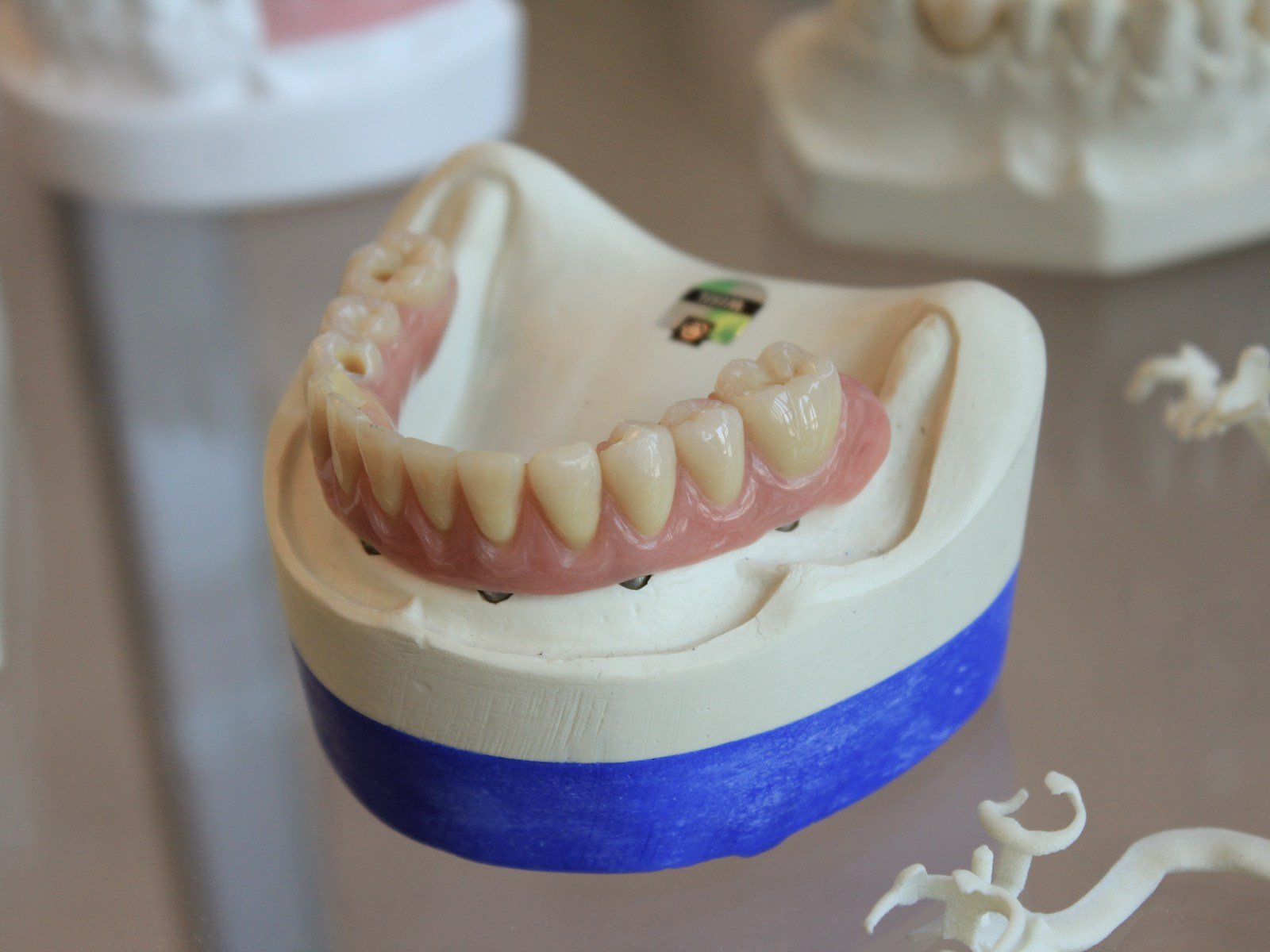
A denture is a set of replacement teeth that you take out to clean. It rests on your gums and, if you still have some teeth, clips gently around them. Older words for it are false teeth or a plate.
A full denture replaces all the teeth in one jaw. A partial denture fills the gaps around the teeth you still have. You can have one in the upper jaw, the lower jaw, or both. Each jaw is made and priced separately.
There are three materials. Acrylic is the most common. It is a hard plastic and it needs some thickness to be strong, so an acrylic denture is bulkier. Chrome uses a thin metal framework instead, so it covers less of your mouth and usually feels better and fits more closely. Chrome is for partial dentures only, because the framework needs teeth to hold on to. Flexible dentures use gum-coloured clasps rather than metal ones, so no metal shows when you smile.
A denture gives you teeth to chew with and supports your lip and cheeks. What it cannot do is work like the teeth you grew. It is a replacement, not the same thing, and the rest of this page is written on that basis.
03
Treatment
Is this right for me?
Teeth are lost for all sorts of reasons: gum disease, decay, an accident, illness, or medicines that dry the mouth. It is very common. We are not here to lecture you about how you got here, and we start from the mouth you have today.
A denture usually suits you if:
You have lost all the teeth in a jaw, or several teeth in a row
Gaps are making chewing hard, or making you cover your mouth when you speak
You would rather not have surgery, or cannot have it
You want something that can be made in weeks rather than months
It may not be the right first choice if:
Only one tooth is missing and the teeth either side are sound. A bridge or an implant may hold better.
You have a strong gag reflex. An upper full denture covers the roof of the mouth, and some people cannot tolerate that.
Your remaining teeth are loose from gum disease. Those need treating first, or the denture has nothing stable to work with.
Very little gum ridge is left, particularly in the lower jaw. A lower denture then has little to hold on to.
The honest alternatives are a bridge, which is fixed in and does not come out, and implants, which are placed into the bone. Both cost more. Implants can also be used to hold a lower denture down, which helps some people who cannot manage one otherwise.
Doing nothing is a reasonable choice too. If you have lost back teeth but still chew comfortably on what is left, you may not need a denture at all. We will say so if we think that is your situation.
04
Treatment
What happens, step by step
Making a denture takes four or five short appointments over about six to eight weeks. The laboratory needs a week or so between most of them.
First we examine your mouth, look at any teeth you still have, and take X-rays if we need them. We ask what you want the denture to do. That matters: someone whose priority is chewing and someone whose priority is feeling able to smile at work may need different designs.
After that, the stages are:
We take moulds of your gums. A first mould is taken in a stock tray, then a closer one in a tray made for your mouth.
We record how your jaws meet, using wax blocks. This sets the height of your bite and where the teeth will sit.
We try the denture in while the teeth are still set in wax. You can see the shape and the colour and tell us what you think. Bring someone with you if a second opinion would help. Changes are easy at this stage and hard later.
The laboratory finishes the denture.
We fit it, check the bite, and show you how to put it in and take it out.
If teeth need taking out first, there are two routes. An immediate denture is made beforehand and fitted on the day the teeth come out, so you are not left without teeth. It needs adjusting or relining as the gum heals and shrinks, and that is expected rather than a fault. The other route is to let the gum heal for eight to twelve weeks and then start. That gives a closer fit, but means a period with gaps.
Then there is the part people are often not warned about. For the first week or two a new denture feels large and strange, and you may produce more saliva. Speech takes practice, and reading aloud at home is the quickest way to get it back. Eating takes longer to relearn: start with soft food cut small, chew on both sides at once, and add firmer food over several weeks.
We see you again about a week after fitting, and usually more than once after that, to ease any sore spots. Please come back rather than putting up with it.
05
Treatment
What it costs
Prices are for one jaw. If you need an upper and a lower denture, that is two of them.
Acrylic denture, one jaw: from £625
Chrome denture, one jaw: from £825
Flexible denture, one jaw: from £825
Each price covers all the appointments needed to take the moulds and try the denture in, the finished denture itself, and the laboratory fee. The adjustment visits in the first weeks after fitting are part of the treatment.
Chrome and flexible dentures cost more because the framework takes more laboratory work than a plain acrylic base. Within each range, what moves the figure is how much the denture has to do. A partial with several clasps and rests takes longer to make than a simple one. So does a full denture built around an uneven ridge. You get the figure in writing after the assessment, before anything is made.
Dentures are also available on the NHS. Complete dentures cost £379.60 before any exemption. NHS charges in Scotland are set by the Scottish Government rather than by us, so they are the same at every NHS practice. Examinations are free for everyone. Around four in ten patients pay nothing at all. That includes everyone under 26, anyone pregnant or within twelve months of giving birth, and anyone with a certificated exemption.
06
Treatment
What could go wrong
Dentures work well for a lot of people and poorly for some. You should know the whole picture before you spend anything.
Sore spots are normal at first. A new denture almost always rubs somewhere. Expect several short visits to ease the edges. That is part of making a denture fit, not a sign that anything has failed. Wear it for a few hours before an adjustment appointment so we can see where it is rubbing.
A lower denture is far less stable than an upper one. An upper denture holds by suction against the roof of the mouth. A lower one sits on a narrower ridge with your tongue and cheek moving against it all day. This is the most common disappointment, and no design removes it. Some people never get on with a lower full denture, however carefully it is made.
You will not bite as hard as you did. Chewing force with a full denture is a fraction of what natural teeth manage. Tough meat, crusty bread, whole apples and sticky sweets are the usual difficulties.
The fit loosens over the years. Bone under a denture slowly shrinks, because nothing is pressing into it the way a tooth root did. Dentures therefore need relining or remaking every few years. We cannot prevent that.
Food gets trapped underneath. Most people rinse the denture after meals. Partial dentures also trap food against the teeth they clip on to. That raises the risk of decay and gum disease in those teeth if cleaning slips.
Oral thrush. A denture worn day and night, or cleaned poorly, encourages a yeast infection underneath it. The gum goes red and sore. Leaving the denture out at night and cleaning it properly prevents most cases.
Clasps can show. Metal clasps on a partial denture may be visible when you smile, depending on where the gaps are. We tell you before it is made if we expect them to show. Flexible dentures avoid metal clasps, but are harder to adjust and reline later.
Speech changes for a while. S and F sounds are usually the awkward ones. For most people this settles within a few weeks of practice. For a few it does not fully settle.
Some dentures have to be remade. Occasionally a finished denture is not tolerated however carefully it was planned. The options then are to remake it, to change the design, or to look at implants to hold a lower denture down.
They can be damaged or lost. Dentures get wrapped in a tissue and thrown out, or dropped and cracked. A cracked denture can often be repaired. Keep it in water or cleaning solution overnight, in a box you can find.
07
Treatment
Who does this here
Principal dentist
Registered name
Tien-Yu Chang
GDC number
296929
Qualification
Grado en Odontología, University CEU San Pablo, 2021
Qualified in
Spain
Associate dentist
Registered name
Li Yang Yeh
GDC number
306420
Qualification
Grado en Odontología, University CEU San Pablo, 2021
Qualified in
Spain
Associate dentist
GDC number
329275
Qualification
Grado en Odontología, University CEU San Pablo, 2025
Qualified in
Spain
Associate dentist
Registered name
Chen Liu
GDC number
331071
Qualification
Dr Med Dent, Semmelweis University, 2025
Qualified in
Hungary
Associate dentist
Registered name
Cheng-Tsung Hsu
GDC number
320342
Qualification
Grado en Odontología, CEU Cardenal Herrera University, 2024
Qualified in
Spain
08
Useful answers
Questions people ask
01How long until I get used to them?
The first two weeks are the hardest. The denture feels bulky, you make more saliva, and your speech sounds odd to you. Most people are talking normally again within a few weeks, and eating a fairly wide diet within two or three months.
If you are still struggling after a month, come and see us rather than waiting it out. It is often something we can adjust.
02Can I eat normally?
Not at first, and with a full denture not entirely. Start with soft food cut into small pieces. Put food on both sides of your mouth and chew evenly, which helps keep the denture down. Add firmer food gradually over the following weeks.
Biting into an apple or a crusty roll with your front teeth tends to stay awkward, so cut those up instead. Denture adhesive helps some people feel steadier, particularly with a lower denture. It is a help, not a repair. If a denture only stays put with adhesive, bring it in and let us look at the fit.
03Do I sleep in them?
No. Take them out at night unless we have told you otherwise. Several hours with the gums uncovered gives the tissue a rest and lowers the risk of thrush and soreness. Keep the denture in water or a cleaning solution so it does not dry out and warp.
The exception is the first day or two after an immediate denture is fitted. We may ask you to keep it in overnight to control the swelling. We will tell you clearly if that applies to you.
04How do I clean them?
Clean the denture over a bowl of water or a folded towel, so it does not break if you drop it. Brush every surface with a soft brush and plain soap or a denture cleaner. Do not use ordinary toothpaste, because it is abrasive and scratches the surface.
Soak it once a day in a denture-cleaning solution, following the instructions on the packet. Rinse it after meals. Brush your gums, tongue and any remaining teeth with a soft toothbrush twice a day as well.
05How often do they need replacing?
Most dentures need replacing within five to ten years, and relining sooner than that. The denture itself wears down and stains. More to the point, your gums and jaw bone keep changing shape underneath it, so a denture that fitted well at first gradually loosens.
A reline adds new material to the fitting surface to take up the slack. We check the fit at your check-up, tell you which you need, and give you the cost before we do anything.
06Can I have them on the NHS?
Yes, where it is clinically appropriate. Complete dentures cost £379.60 before any exemption. NHS charges in Scotland are set by the Scottish Government, not by us, so they are the same at every NHS practice.
Examinations are free for everyone, and around four in ten patients pay nothing for treatment either. We will tell you what you can have on the NHS and what a private denture adds, so you can compare the two properly.
07Will people be able to tell?
Usually less than you fear. A denture is designed around your own face, your lip support and the shade of any teeth you still have. We can build in the small irregularities of natural teeth if you would rather that than a very even set.
What tends to give a denture away is a metal clasp on show, or one that has loosened and clicks while you talk. Both are worth telling us about. We would far rather adjust something than have you stay quiet about it.
09
Treatment
Next step
The first step is an assessment. We look at your mouth, ask what you want to be able to do again, and tell you what is realistic. You leave with the design, the material and the price in writing, and no obligation to go ahead.
You do not need to have decided anything before you come, and you do not need to apologise for the state of your teeth. If you have been putting this off, you are in very ordinary company.
Call us and ask for a denture assessment.
Or call us on 01592 348674 if you would rather talk it through first.
Keep exploring
Helpful next pages.
01
Local guideYour local dentist in Glenrothes
02
TreatmentDental implants in Glenrothes & Fife
03
TreatmentUrgent dental care in Glenrothes
Here in Glenrothes
Ready for a clearer next step?
Contact reception about registration, current appointment availability or the right first visit for your concern.
Glenrothes Dental House2 Huntsmans Court
Glenrothes, Fife
KY7 6SX
Glenrothes, Fife
KY7 6SX